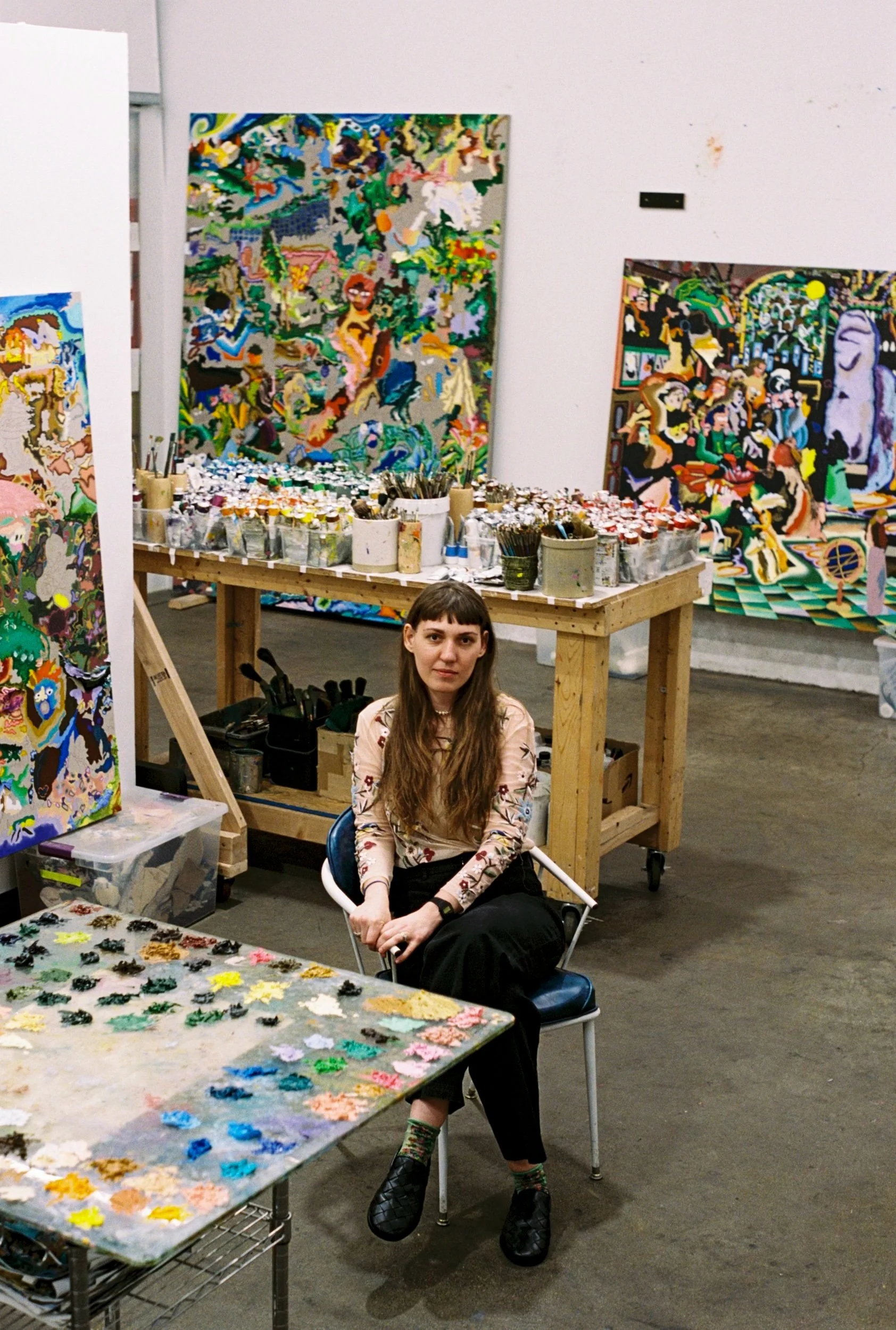
Cindy Phenix (b. 1989 in Montreal, Quebec) lives and works in Los Angeles, California. Phenix is a multidisciplinary artist whose practice advocates for ecocentric thinking. Phenix received an MFA in Art Theory and Practice from Northwestern University in 2020 and a BFA with distinction from Concordia University in 2016. Phenix has exhibited at renowned institutions, including solo at Victoria Miro, Vortic; Makasiini Contemporary, Helsinki; Nino Mier Gallery, New York, Los Angeles and Brussels; Galerie Hugues Charbonneau, Montreal, and Maison de la Culture, Longueuil. Group exhibitions include Paul Smith Space, London; PM/AM Gallery, London, Torrance Art Museum, Torrance; Vielmetter, Los Angeles, Megan Mulrooney Gallery, Los Angeles; Hyde Park Art Center, Chicago; Julius Caesar, Chicago; Contemporary Art Gallery, Vancouver; Museum of Fine Arts, Montreal; Clark Center, Montreal; Stewart Hall Art Gallery, Montreal among others. Phenix's practice has been featured in the New York Times, Flaunt, Art21, Art Net, A Women's Thing, Esse arts + opinions, and Border Crossings. Cindy Phenix’ work is found in the permanent collection of the Musée d’art contemporain de Montréal, Musée des beaux-arts de Montréal, Musée national des beaux-arts du Québec, Collection BGL, Caisse de Dépôt du Québec, Claridge, Hydro-Québec, and Gris Orange Consultants.
Biography
Cindy Phenix works at the intersection of painting, drawing, textile and sculpture, merging abstraction and figuration. Phenix vibrant, fractured compositions suggest ambiguous narratives related to systems of power, social convention, and the environmental crisis. Each scenery is populated by chimerical figures, amoebic forms, and elements of architecture and landscape that intermix, dissolving and cohering in abstract gestures. The eye moves between passages where narrative figuration is foregrounded and those that revel in the raw materiality. Characters - often monstrous or spectral - recur across Phenix’s compositions, creating an overarching sense of a fugue-like universe in which the artist plays out utopian and dystopian scenarios.
Collage guides Phenix’s work, both technically and conceptually. Drawing from archival materials that span scientific imagery, natural history publications, and art history, Phenix digitally construct collages, abstracting and enlarging details and playing with context. Then projects these images onto surfaces and traces the projected outlines, incorporating distortions from shadow and light. Phenix works with a variety of materials, watercolors, pastel under clear gesso, oil paint mixed with wax, textiles, and mosaic on poplar structures. For Phenix, the collage form reflects notions of synthesis, collectivity, and unity - conditions that might offer an antidote to the exigent social and environmental issues of our time.
Interconnectedness is fundamental to Phenix’s work, which is grounded in an ecocentric perspective that situates humans as one element within a larger web of life. Phenix meditates on ecological transformation, decay, and renewal to envision reciprocal relationships among species. Microorganism, minerals, flora, marine life, insects, animals, and humans inhabit shared space, none privileged over another. Forms remain mutable and in flux, emphasizing their continual interdependence. In this way, Phenix transforms anxiety and sorrow into a language of hope.